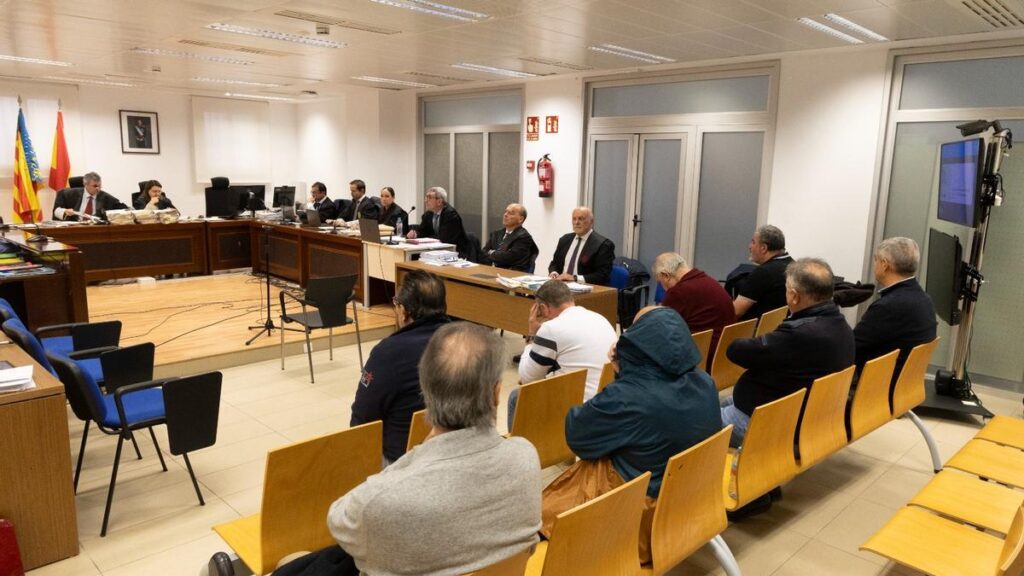
Twist on the case Waters of Calp. Two of the eight defendants pleaded guilty this Wednesday and admitted to having acted as front men for Francisco Artachobrother-in-law of the then councilor and provincial deputy of Aguas Juan Rosello. The investigation points to Artacho as one of the main people responsible for the framework to execute the renovation works of the municipality's water network. Both processed They faced requests for up to seven years in prison on the part of the Anticorruption Prosecutor's Office and now they have chosen to collaborate with Justice.
According to the accusations, the mixed company Aguas de Calp commissioned the work in 2004, valued at 4.5 million euros, to the merchant Levante Hydraulic Works (OHL)a firm with no real activity that subcontracted the work to another company, which in turn referred it to third companies. According to the accusations, on that journey he disappeared about a million euros and several suppliers were left unpaid. The purpose, the accusations maintain, was to hide who was really behind the works given his family relationship with Roselló, then responsible for the Water Cycle in the Provincial Council.
“They asked me to please appear,” declared one of the accused, Victoriano Sanchezwho is attributed to being one of Artacho's front men. “I wasn't aware of what was happening. I was authorized on the account and signed checks, but I didn't know what was happening. One day I found myself at the table a check of 180,000 euros for him to sign it; I asked what it was for and I didn't want to know anything else. “I didn't understand,” he said. He also insisted that the company “I didn't have the infrastructure to run anything.. There was no machinery, no trucks, nothing.” In his statement he launched several accusations against Artacho, stating that about him “There were all kinds of stories about his relationship with Roselló. He had three bungalows and went from a boat to a miniyacht,” adding that “they ordered twenty and charged a hundred.”
Obras Hidráulicas de Levante was born after the purchase, by the network, of the mailbox companydedicated to the distribution of advertising, which just a few days after the award began to deal with public works. The one who had been its main shareholder, Antonio Ramón Céspedes, He was the second defendant to plead guilty. “Buzoneo was my ex-mother-in-law's company and I agreed to appear so that it would not be seized,” he explained. He added that, after the sale to Artacho, he asked him to sign several blank documents in exchange for helping you with some problems with Social Security. “I was aware that what I signed It was being used for something criminal.so I have to take responsibility for what I did,” he concluded.
A third defendant also charged against Artacho's alleged fraud, although he did not plead guilty to any crime and presented himself as another victim of the scheme. Salvador Ibarra, responsible for the commercial Montubospointed out that his company was the one that carried out the work with the support of others that he hired. “They stopped paying me and that's why I couldn't pay,” he said, acknowledging the debt owed to two of the companies that accuse him of being harmed. Exca-Gata and Vives Dalmauto whom They were owed 245,000 and 83,000 euros. As he explained, he received nearly one million euros in promissory notes that turned out to be unfunded. He stated that He continued requesting material and hiring because “he was convinced that he would get paid. That was my ruin. “I lost everything.” He linked those non-payments with the moment in which Artacho's links with the contractor of the works came to light.
Ibarra said that his company was dedicated to the supply of pipes, an activity through which he met Artacho and with whom he had collaborated on several projects, in which a friendly relationship developed. According to him, Artacho told him that there was “a great project in Calp” and that they could give him the work. “Adjust prices; if you adjust them, you keep it“, he assured that he told him during a trip with the Calp corporation to a water fair in Zaragoza. An event for which, as he stated, “I paid the accommodation expenses of the Calp delegation.” For that reason he had attended the fair with a proposal already drawn up. The plenary session approved the projects a month later. “A budget of five million was nonsense. “That's not worth that much,” he said. He also denied that Montubos had been created expressly to carry out the works: “We had works everywhere,” he said.
“A yacht for everyone”
The businessman pointed out that, upon accepting the OHL job, he realized that it was a company without means. “I trusted Artacho because I had already worked with him and I lost,” he lamented. A tone that contrasted with the moment in which they signed the contract: “Artacho and I went out for lunch to celebrate, we got drunk and we each bought a yacht.. And I also have five Vespas. Then I regretted it.”
For his part, the former provincial deputy and former councilor of Water Juan Rosello He assured that he did not know that his brother-in-law was behind the company that carried out the works. “I found out from the press,” he said. Roselló only answered questions from his lawyer, claiming that he had already testified extensively on this matter on his day in court. He maintained that his brother-in-law's companies were in charge of works throughout the province. “When they put me in charge of the Water Cycle, I told him that abstained from participating in the Provincial Council's contracting processes and I instructed the technicians to withdraw their companies from any call. He told me that I had annoyed him,” he said. He insisted that he had nothing to do with the awarding of the works. “The proposal was from the Mayor's Office and my brother-in-law did not appear in the award,” he said.
Along these lines, Artacho stated that he negotiated the contract with Aguas de Valencia at the time. “They had told me that an important project was going to be awarded and I contacted his directors to tell them that I was interested,” he said. He only answered questions from his lawyer, José Javier Sáez Zambrana. The defendant defended his long experience as a businessman in water projects and blamed some of his employees maneuvers to divert funds from work. Both Artacho and Roselló questioned the conclusions of the investigation commission, ensuring that it was “illegal” and that the complaint he filed was political. As he explained, the purchase of Buzoneo was due to the fact that they intended to expand the group's activity and then it was common practice to buy disused companies to reconvert them. Artacho insisted that the work was completed on time and has not had a single problem in twenty years.
The trial continues this Thursday with the testimony of two other defendants and, then, the conclusion reports will begin.
Subscribe to continue reading