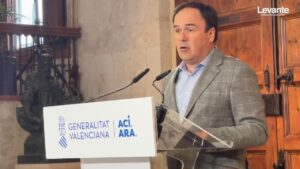
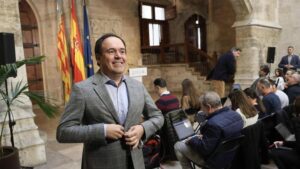
Finestrat became the scene of an unusual political gesture in times of polarization exactly a year ago. The then mayor, Juanfran Pérez Llorcadecided to dedicate a municipal park to the historic socialist leader Miguel Llorcawho governed the town of Marina Baixa for more than two decades. That day the plaque with his name was placed. A year later, Pérez Llorca has experienced his investiture as president of the Generalitat thanks to the votes of Vox, but he maintains that tribute as one of the most symbolic decisions of his local stage as a local leader.
He municipality of la Marina Baixawith about 10,000 inhabitants, was for many an example that another possible policy still exists. In a context of noise, tension and permanent confrontations, the climate that its two longest-serving mayors cultivated for years—one from the PP and the other from the PSOE—contrasts with the dominant dynamic in the regional and state spheres. There, the discrepancies They did not prevent them from maintaining a mutual respect that both consider essential for public life.
emblematic space
The park renamed Miguel Llorca is an emblematic space of the municipality: more than a thousand square meters of Mediterranean vegetation, water, walkways and areas for citizen use that the socialist promoted in his broad mandate. He was mayor since 1981, just two years after the first democratic municipal elections, and maintained six consecutive absolute majorities until 2007. His retirement for health reasons opened the door for the arrival of the PP to the Mayor's Office. In 2015, Pérez Llorca took office and has since chained rswollen electoral resultssuch as the 74% support obtained in 2023.
The tribute was approved by unanimity of the Plenary —eleven councilors from the PP and two from the PSOE— and sought to recognize the work of the person who has governed the municipality the longest. “The tributes must be made while alive,” Pérez Llorca defended then. Miguel Llorca, visibly moved, thanked the gesture and understood it as a call to preserve the dialogue-based policy: “It is a good example for future generations.”
Those days both shared conversations that summarize that political coexistence. Pérez Llorca recalled that, since he arrived at the City Council, he has not removed plaques or references from previous stages. The socialist corroborated this: “It hasn't taken away anything I did.” And he himself recalled an anecdote from the eighties to illustrate a closest policy: One morning he coincided with Luis Díaz Alperi, then leader of UCD, who was looking for colleagues to put up posters. “I helped him. Those were different times,” he said.
The event also had space to talk about current events, marked then by the devastating effects of damage in the province of Valencia. The former mayor showed his support for the popular party in the midst of the political crisis derived from that administration. “He has a lot of future, he is very smart,” he said, in a prediction that makes more sense today. Pérez Llorca, for his part, insisted that he continues to ask advice from someone he considers one of his references: “I learned from the best.”
Political coexistence
In the background of the tribute was also the conviction that political coexistence start locally. The socialist regretted the state tension and defended the two-party system as a way to recover stability. Pérez Llorca, although more cautious, agreed that the political climate will change: “It will pass, although not in the short term.”
The meeting concluded with an exchange of words that sealed that complicity between two generations. Miguel Llorca expressed his wish that the now president of the Generalitat receive similar recognition one day. Pérez Llorca rejected it with laughter: “I don't want anything.” But he did admit what his immediate satisfaction: “I will be happy when I see your name on this plate.”
Now, a year after that tribute from a PP mayor to a socialist predecessor, Pérez Llorca has become president of the Generalitat thanks to the votes of Vox.
Subscribe to continue reading