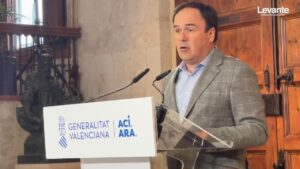
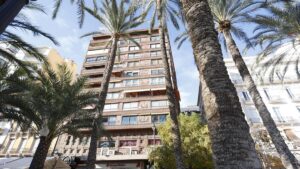
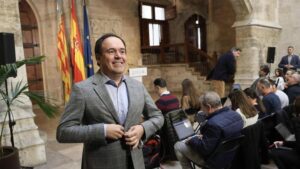
days of changes for the already former president of the Generalitat Carlos Mazón. Change your position, your position in the Valencian Courtsalso his emoluments and, without spending a day outside the Palau, he has already activated his Office of the Former President. Mazon He has already chosen an office for his new post-presidential stage. The man from Alicante, who maintains his record as a deputy of the PP in the Corteswill be installed in the known as Monaco buildinglocated at number 2 of the Ingeniero Lafarga streetone of those that connects the Esplanade walk with the San Fernando street.
Mazón, as of this Tuesday, was entitled to a series of prerogatives included in the Statute of the Former President. Specifically, that office, along with two advisor positions, an official vehicle and a driver. The appointments of its collaborators will be formalized through the Official Gazette. These rights are for life. And they go in parallel to others that at the moment Mazón does not seem to be going to activate, such as his entry into the Consell Jurídic Consultiu as an ex officio member, which would mean a salary of 75,000 euros per year for two and a half years, the same time that he has remained in the Palau, not exceeding the full term, which would have given him the right to fifteen years of full salary within the Jurídic.
The former president will set up his office at 6ºB of a tiny street, which leads to the emblematic promenade. As can be seen on the exterior wall of the property, the floor corresponds to the Alicante Provincial Consumer Arbitration Boarddependent on the Department of Innovation and today located in the nearby Cervantes Street.

Plaque of the Generalitat Valenciana in the Mónaco building in Alicante. / Alex Domínguez
The chosen building, in addition to being central, is one of the most unique in the city. It dates back to 1969, two years after the work began, and is the work of Juan Guardiola GayáCatalan architect responsible for the design of various buildings in the city, especially between the Albufereta y San Juan Beach.
Monaco Building
As for the Mónaco building, its name comes from the homonymous cafeteria previously located on the same property. This is how he remembers it Alfredo Campellomember of the cultural entity Alicante Livewhich highlights the socarato tilesof baked clay and extensive tradition, that cover the façade. These works also distinguish the block as “the house of murals.”
The property houses ninety murals on its façade with maritime and historiographic themes, as well as mythological elements.
The person who detailed this building the most was Paco Almiñanaknown for his blog “Alacantí de profit”, now deceased and who once dedicated an extensive article to the architectural work. Its nine floors, to which we must add the ground floor, mezzanine and attic, measure between 105 and 175 square meters (according to the sales advertisements from almost sixty years ago), and have ninety murals on the façade on the outside with maritime and historiographical themeas well as with mythological elementsjust as Almiñana described.

Detail of the ceramics that decorate the Mónaco building in Alicante. / Alex Domínguez
In one of these murals it is read that the construction of the building was commissioned by the company Bernal Pareja SAand the murals that decorate the façade were the work of María de la Asunción Falcó. Its uniqueness motivated the late Almiñana to request the City Council that the building be included in the Protection Catalogalthough today it still does not appear in it. “I can't find a reason why they haven't added it,” says Alfredo Campello.
Today, what surrounds the building is a symptom of the evolution of Alicante, especially its tourist heart. A fast food restaurant, an ATM, an optician and a supermarket that includes mobile repair are the closest businesses, to which must be added the hospitality establishments from the Explanada and San Fernando Street. A different landscape from the sixties, when tourism had not yet reached current levels of influx and when this building by Juan Guardiola, an architect who died in 2005 and whose work is very visible, was completed.
John Guardiola
Guardiola, born in Reuslearned the trade in Barcelona from the hand of another architect, Francis Mediumwhile he was inventing the Camp Nou. At the end of his fifties, just in his thirties, Guardiola arrived in Alicante with the order to build the first polygon on San Juan beach.

Ingeniero Lafarga street, where the Mónaco building is located, seen from the Esplanade. / Alex Domínguez
His practice was prolific and his imprint, spread throughout the Alicante coast, is recognizable to the eye of the connoisseur. One of his crowning works was the La Rotonda urbanization, which turns 60 in 2025. Iconic for the pagoda shape of its main tower, It was a milestone in Alicante architecture and also for its location, which indicated the beginning of San Juan Beach with respect to Cabo de la Huerta.which then still had scattered chalets, such as the La Ratita apartments, still standing, behind what would later become the El Cabo hotel. A few years later, another large construction would arrive on the beachfront, the Sidi hotel, and progressively a series of developments that would populate La Dorada street and its surroundings up to the lighthouse path.
The Rotunda is also original due to the range of buildings it contains. The urbanization consists of 122 homes distributed in several townhouses, a six-story block and the famous 18-story tower, which is the most significant element.
Urbanizations such as the Torre Vistamar or the Chicharra, which he gave movement with a curved shape to embrace the bay, are also his. Later he would build the first skyscraper in Benidorm. Former president Carlos Mazón will install his office on a floor of the most central building of those designed by the Catalan architect.
Subscribe to continue reading