In the cozy lounges of the Roland-Garros stadium in Paris, representatives of French sport did not meet to talk about winning setbacks or sporting calendars, but about an invisible adversary who directly threatens the economy of competitions. Broadcasters, rights holders, public authorities, specialized police officers and regulators come together to draw up an observation that has become impossible to ignore, all in front of a large audience of journalists. Audiovisual piracy, long considered a simple technological nuisance, has transformed into a massive phenomenon driven by the explosion of illegal IPTV subscriptions. For a few euros per month, these services provide access to all the major events in world football, from the Champions League to the major European championships, completely bypassing the official broadcasters. In France, the most recent estimates suggest nearly 8 million illegal IPTV boxes or subscriptions in circulation. The shortfall for the sporting ecosystem is colossal, around 400 million euros per year, an amount close to all domestic television rights for Ligue 1. At a time when French football is going through a period of economic uncertainty and trying to preserve the fragile balance of its model, this silent siphoning weighs heavily. Behind each match watched illegally, there are revenues that escape clubs, broadcasters and an entire system which is based on the value of live sports.
But the issue now goes beyond just the economic question. What the speakers gathered in Paris describe increasingly resembles a problem of security and organized crime. Pirate streams, illegal streaming platforms and IPTV networks now constitute an extremely lucrative global market, often controlled by mafia structures capable of operating on an international scale. Piracy of audiovisual sports content represents several tens of billions of euros in losses each year worldwide, with football as the main target. In Europe, a significant proportion of sports fans admit to having already used a pirate service at least once to watch a match. The trivialization of the phenomenon particularly worries broadcasters and leagues, because it gradually transforms illegal access into a cultural norm among part of the public. For the French authorities, the question is no longer just to protect television rights, but to defend an entire sporting model. Audiovisual rights finance training centers, infrastructure, the competitiveness of clubs and, more broadly, the economy of professional sport. As pirate networks become more sophisticated and illegal subscriptions multiply, the battle becomes a real race against time to preserve the value of the sporting spectacle and prevent French football, already weakened, from seeing its economic model further cracked.
A real fight to wage for French football
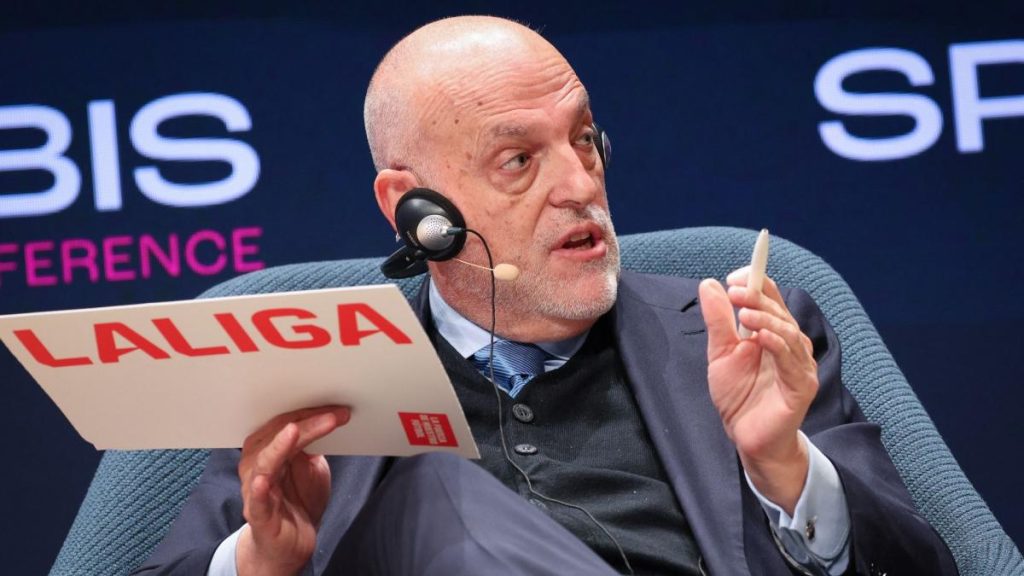
Present in Paris, Javier Tebas took the time to detail the fight he has been actively waging for several years in Spain. An example from which France hopes to draw inspiration. “There are no big differences between Spain and France in this fraud. There are also IPTV, VPNs, peer-to-peer… We managed to have two court decisions which were able to attack piracy. We were able to dynamically block during live events. But the blockage is slower in France. When we find new rules, the pirates are still far ahead of us. We have a team monitoring the progress of this hack. You have to know very well the traceability of these pirates, the initial source. This is a call to you, France. I traveled to China to discuss piracy. We have detected cybercrime groups that control everyone. They are important and active in Kurdistan, Bulgaria, Armenia and China. These are pyramid structures. These groups work their way to the top. They buy tools to develop technologies», he declared at this Parisian event organized by the Association for the Protection of Sports Programs (APPS). According to an official La Liga clip released before his intervention, the Spanish league is losing between 600 and 700 million euros due to piracy and nearly 194,000 jobs are at risk. On the French side, piracy today represents a major challenge for the broadcasting of football. Ligue 1 is by far the most pirated competition, with 54% of people watching football admitting to viewing it via illegal means.
The price of subscriptions remains the main reason given by users. According to estimates, 59% of fans have already watched Ligue 1 through unofficial channels, or nearly two million people, resulting in a shortfall of several hundred million euros for broadcasters and football players. Furthermore, 18% of supporters even say they refuse to pay to watch matches. “We had to change our mindset. The subject was gaining momentum. There is a change of strategy. We had to convince the judges and the courts to pass new legislation. We did not have a framework like the French Senate. We had to persuade them with intellectual and audiovisual property. It was about doing in-depth legal work. All the major audiovisual players in Spain had to be integrated and convinced. Their collaboration is essential. They were either on the stealing side or working with us. It was also necessary to convince those involved in technology and communication. Our team places emphasis on traceability for this fight. You must have proof to block content. You cannot block an IP address or IPTV without proof of piracy. We must take the host number, photos, and we communicate this proof to the actors of our collaboration. Everything can happen in 3 minutes. What we are blocking in Spain does not only concern La Liga but also Ligue 1, Formula 1, Netflix…», added Tebas who specified that LaLiga has invested nearly 12 million euros to fight against piracy. Piracy has been reduced by “almost 60%» in Spain in recent years, according to the president of the institution.
«The technology used by hackers has two aspects. They use technologies that we created. It’s a matter of seconds. They change from one IP to another IP quickly. By the time it took to send the evidence, they moved to another host. We use AI to anticipate things. We are now working on peer-to-peer. These are linked computer networks. Per day, 30,000 IPs are blocked in Spain, including 9,000 IPTVs. 40 euros per month, that corresponds to 10 euros per weekend and 3 euros per day, it’s not expensive for entertainment“, he concluded. Despite the scale of the phenomenon, sports and audiovisual players want to believe in a turning point in the fight against piracy. Legal tools are strengthening, detection technologies are progressing and operations to dismantle IPTV networks are increasing in Europe. The Spanish example led by Javier Tebas shows that an offensive strategy, coordinated between leagues, broadcasters and authorities, can produce concrete results. For the speakers gathered at Roland-Garros, the battle is far from over, but it is no longer endured. With better international cooperation, greater technological innovation and general political mobilization, French sport intends to regain the advantage and defend the value of its competitions. From the great cathedrals of European football, from FC Barcelona to Real Madrid, from Paris Saint-Germain to Bayern Munich, to Liverpool and Manchester City, there is now a common conviction to preserve the magic of the game and the value of the spectacle. Football must lead this fight with one voice. And it started at Roland Garros on the lands of Rafael Nadal’s successes.
Pub. the
– UPDATE