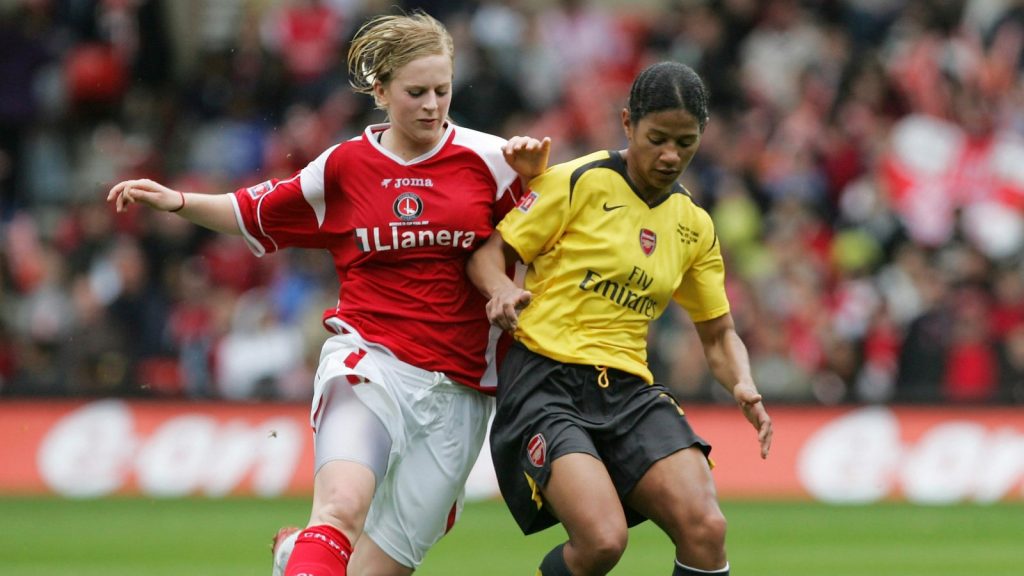
Born in 1977 and raised in Peckham, former Millwall Lionesses, Fulham, Arsenal and Chelsea defender Mary Phillip enjoyed a distinguished playing career and is currently enjoying a distinguished coaching career too.
Phillip was a key member of Arsenal’s quadruple-winning side in 2006/07 – “it was actually the quintuple; we won the Charity Shield too!” she will later remind us.
Phillip was the first Black player to captain England and she now coaches Peckham Town’s senior men’s side, becoming the first female coach to win a trophy with a senior men’s side in the process. For Phillip, as the strong London theme to her playing and coaching career suggests, football has always been about community.
“I used to play with my brothers and sister and all the kids in Peckham. We played every sport but football was the big one,” she says.
Phillip’s career owes much to a couple of chance encounters with community figures. “I wanted to play football at school, but the boys would never let the girls play. Then one lunchtime a teacher came over and said, ‘If you don’t let the girls play, we’ll make it girls only!’
“Then I could play football at school as well as outside. Somebody stood up for girls to play on that day and that’s where it all started.”
An even more chance encounter with another community figure proved to be the next stepping stone on her road to the top of the women’s game.
“I loved playing but in the 1980s and 90s we were unaware of women’s football or that women’s football teams existed. I was just playing with a football near my house with my sister and a friend, and a youth worker saw us and told us she was starting a women’s team.
“She met our parents and explained what she was doing, so I joined that team and a world of women’s football was opened to me.”
Phillip remembers another transformative moment: seeing her local women’s team on TV in the days when the Women’s FA Cup final was the only televised women’s football all year.
“One Sunday in 1991, I came inside the house and Millwall Lionesses were playing Doncaster Belles in the FA Cup final on TV and I realised elite women’s football existed. Millwall were my local team and the next year, I joined them.”
Mary says she was thrown… well, not quite straight to the Lions, but straight into adult football at a young age. “There were no under-18s, under-16s or under-13s – if you played you were in the women’s team,” she recalls. “At 13 years old I was playing with women twice my age and learning how to take responsibility, be accountable and how to hold your own on the pitch.”
In 2000, Fulham became the first fully professional women’s football team in England, and Mary Phillip from Millwall was high up their wanted list.
“I was working with Millwall in the Community and coaching, but playing football was my first love and there was an opportunity to go and play full time. I had my children at the time so that was ideal. I got in touch with Fulham and they invited me down and I was offered a contract, which I took with both hands!”
Fulham became very successful, winning the domestic treble in 2002/03. But they reverted to semi-professional status and the project burned out. In 2004, Phillip was looking for her next move and there was one place her eye fell. “I was looking at going to Arsenal before the move to Fulham.
“When the Fulham project folded I got in touch with Arsenal. At first I was told I wouldn’t get into the team and I wasn’t what they were looking for, but I went down to train and I ended up having four very successful years there.”
With school-age children, Phillip needed to adapt to returning to semi-pro status, even if Arsenal were the leading team in the country. “I had to go back to training from 8pm to 10pm, and that made childcare difficult. But there was a will, so there was a way!
“My parents were really supportive and took care of my children while I was at training in the evening, I worked full time during the day. It was a juggling act but I wouldn’t change any of it.”
Phillip quickly realised that Arsenal, who had been dominant domestically prior to Fulham’s brief rise to professionalism, were in a position to reassume their dominance.
“We were all quite different but when we played, magic happened. We had so much quality – Jayne Ludlow, Emma Byrne, Julie Fleeting, Kelly Smith… so many players – and we clicked together. We just grew in strength and confidence and it all came together when we won five trophies in one season – people forget we won the Charity Shield too!”
The Gunners became European champions in 2006/07 and famously went into the UEFA Cup final against Umea as underdogs, with Kelly Smith suspended and captain Faye White making her first steps back from an ACL injury. Phillip says the team rolled with the punches.
“We were highly adaptable in how we trained, everyone knew their role but, more importantly, everyone knew everyone else’s role too.”
Arsenal had to adopt a more disciplined, defensive style against Swedish side Umea, who were fully professional at the time and boasted world-class talent like Marta and Hannah Ljungberg.
“We just grew in strength and confidence and it all came together when we won five trophies in one season”
“We were able to support and double up when we needed to. Faye was coming back from injury so Anita Asante came in and she was an amazing player – she took to it like a duck to water.
“We modified our game a lot but we were able to because we knew each other’s roles.” Phillip admits that she saw a lot of the same qualities when the club repeated the feat by winning the Champions League last season by beating Barcelona 1-0 in the final on that glorious day in Lisbon.
“They were just like us – underdogs for that final – and I saw that same spirit within them. I could feel the same passion I had in the Umea game; you could sense it the nearer it got to the end. It was fantastic to see that Arsenal had won the Champions League again.”
Phillip was part of a team that boasted a lot of talent from inner city London and a team that was racially diverse; in more recent years, women’s football in England has struggled to identify and retain talent from inner city communities, which has had a disproportionate impact on Black and Asian girls.
“I still live in Peckham in the inner city and I see so many young girls who don’t know how to get into a local team. I try to direct them, but it’s difficult,” she explains. “Even London City Lionesses, who used to be Millwall Lionesses, have had to go out to the suburbs.
“It’s difficult for kids from inner cities to get to these areas – their parents can’t always drive them. A lot of talent is being missed. I have spoken with Talent ID people at the Football Association. The FA are doing a lot of work linking up with local centres of excellence so inner city kids don’t have to travel for longer than an hour. But it has been a slow process.
“I run an under-13s girls’ team and I still don’t really know how to direct girls to these centres. I ask myself whether players like me, Alex Scott, Rachel Yankey, Lianne Sanderson or Anita Asante would be spotted now because we were all inner city girls and that is a pool that has been missed recently.”
Phillip left the Gunners to join Chelsea in 2008 but made the decision to retire from playing soon afterwards.
“I was talking to one of my good friends in the game, Tina Lindsay, and I told her I was enjoying playing but not as much as I used to. She said I might just need a change of team, and if I still felt the same after pre-season at a different team I would know I had tried something and I knew it was time.
“It made sense for me to change scenery before I took the decision but I just wasn’t enjoying it as much. I was doing a lot of travelling and my oldest son had just started secondary school and I wanted to be there for him. My youngest was at primary school. The season started and we had an away game and I just wanted to be at home with my kids.
“I made the decision that day. After the game I told the manager I was going to stop playing and I hung my boots up that day.” Phillip was involved in coaching at her local team, Peckham Town, where she now manages the senior men’s team.
She explains that she had caught the coaching bug at the expense of playing: “I was still coaching at Peckham Town in the youth sides and my heart just started flowing to the coaching side. I was involved with the youth teams. It’s a voluntary role so I am there because I want to be there.”
It’s such a community-based club and it has a warm family feel to it. I’ve been a part of that and helped it to grow.”
For Phillip, part of the attraction of coaching is giving something back. “I have a passion for giving back to the community I grew up in and played football in, and I have the chance to give some of that to other people – especially when I was coaching the youth teams and I was able to see those players grow up playing the game.
“It’s such a community-based club and it has a warm family feel to it. I’ve been a part of that and helped it to grow. I really love being at the heart of grassroots football.”
She says she would potentially be interested in a role in women’s football, but on one condition: “If an opportunity came up in the women’s game or the youth side of the women’s game, if it suited me and my family, I would be for it 110 per cent, but it has to fit my lifestyle and my family.”
Phillip’s world changed in 2017. “I was diagnosed with multiple sclerosis; it shook my life. I was an elite athlete and just never realised I had it.
“In my playing career I had gone through illnesses and little things in my body not realising what it was. I didn’t always go to the doctor, I just carried on. Then in 2017, I had a major relapse and was unable to move my whole right side. It shook me up.”
Mary says she has learned to live with the condition and is now able to properly treat it: “Once I got my head around it and fully understood it I realised I had gone through my life with this illness and it just didn’t have a name – I didn’t know what was going on.
“Now it has a name and I understand it, I’m just fully aware of it. I take a disease-modifying drug to help slow it down. It is part of my life; I have more good days than bad. I went through my whole football career not knowing where this pain was coming from.
“Sometimes I couldn’t sprint or I had pains in my hand. I was told it was neural and not an issue it was only years later it was diagnosed as MS.”
Phillip’s career has been a story of talent and success, but also one of community and family and of overcoming obstacles in ways that she didn’t even realise until long after her retirement.
Copyright 2026 The Arsenal Football Club Limited. Permission to use quotations from this article is granted subject to appropriate credit being given to www.arsenal.com as the source.